Profile: Shaun Markham on inclusive workplaces
Jacqui Gibson finds out what an inclusive environment can achieve when she talks with Reserve Bank of New Zealand analyst Shaun Markham, who has athetoid cerebral palsy
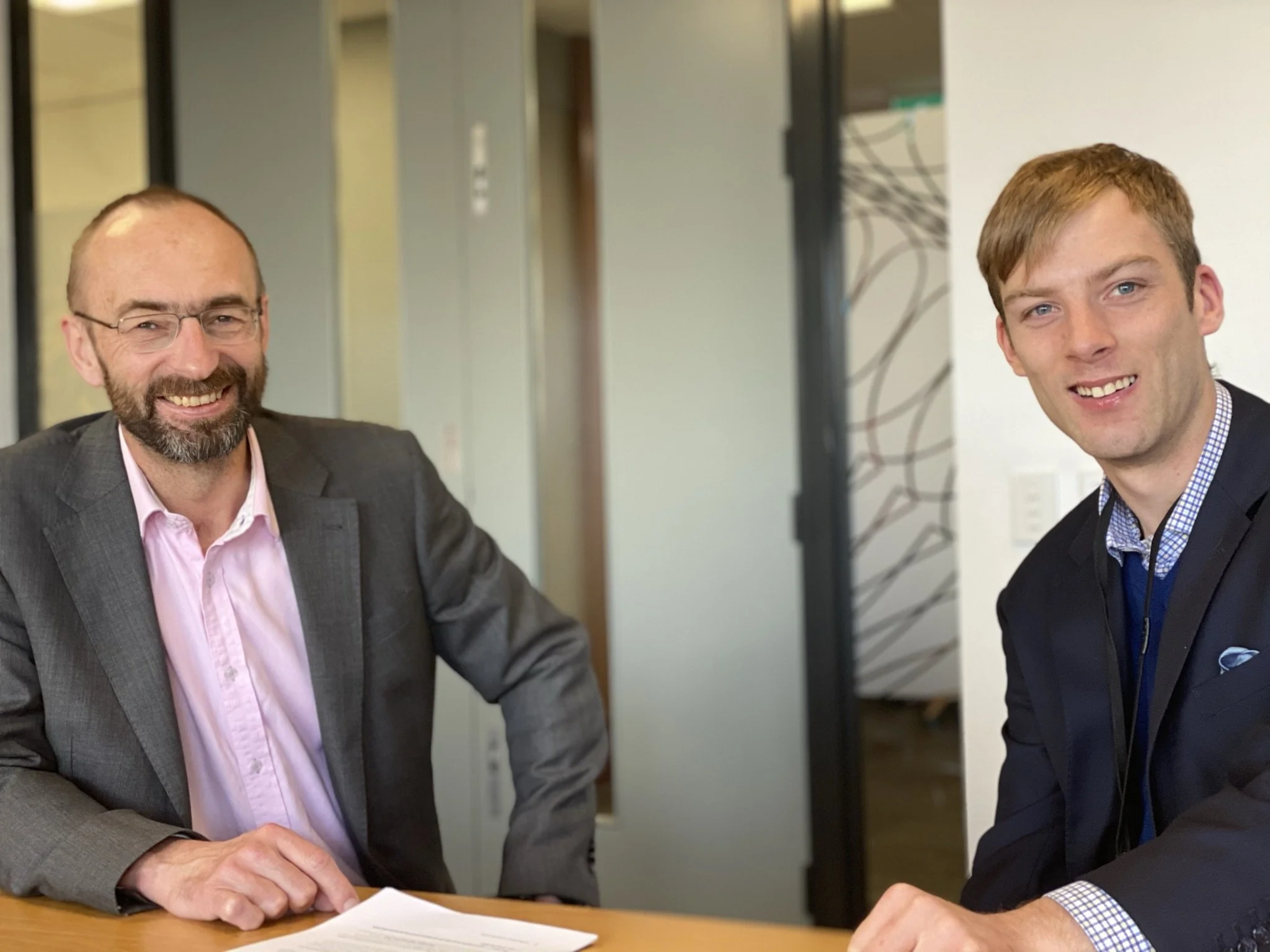
Reserve Bank financial system policy manager Cavan O’Connor-Close and analyst Shaun Markham (image by Jacqui Gibson).
Shaun Markham reckons he's heard it all in his 26 years.
Some of it’s been good—like the time when his economics teacher said he had the smarts and drive to get the Reserve Bank’s top job one day. (Watch out, governor.)
And some of it not so good.
“Many people assume because I’ve got cerebral palsy I’m not capable,” explains Shaun over juice (him) and coffee (me) at Mojo on The Terrace in Wellington.
“They think I don’t have goals or dreams. Someone I met recently was shocked I even work at the Reserve Bank. They said stuff like: ‘Wouldn’t it be easier and less costly to the country to stay at home with your parents and live on a benefit?’”
Shaun ignores this kind of comment.
Meeting goals
Shaun joined the Reserve Bank in November 2019 with a master’s degree in economics from Otago University.
It was a hard-won qualification, yet it was the ticket to a career he’d wanted since high school.
Hard won, he says, because having athetoid cerebral palsy means he works harder than most to achieve and meet his goals.
Athetoid cerebral palsy affects his motor skills, balance, and speech. It also causes him to tire quickly.
“I want people to know it doesn’t define me. Sure, it’s often the first thing others see. I’m wobbly on my feet. People have to concentrate to understand what I’m saying. But, like most people you meet, I want a job I enjoy and the opportunity to contribute in a meaningful way.”
Shaun, who lives in Thorndon, a doable walk to work, says he wants to speak up and share his experiences in the hope that doing so might challenge public assumptions and open doors for other people with disabilities.
“Disabled people, overall, have a heightened awareness and lived experience of so many issues. We’re great people to have in any workplace, but government particularly. I know first-hand the impact of government services and how important they’ve been in my life.”
“Disabled people, overall, have a heightened awareness and lived experience of so many issues. We’re great people to have in any workplace, but government particularly. I know first-hand the impact of government services and how important they’ve been in my life.”
Growing up in Sawyers Bay, Dunedin, Shaun relied on teachers well-versed in inclusive education.
He enjoyed the support of a college principal who not only showed leadership on issues such as inclusion and diversity, but also made major improvements to the school so Shaun could get around.
Shaun was dux of King’s High School, which gave him plenty of opportunity to talk publicly about the importance of inclusion.
He credits the support of talented physiotherapists and skilled teacher aides for his success at a mainstream school.
There were reader-writers for exams and specialist computer gear for the classroom.
The Ministry of Education’s transition team, who helped him plan and settle into university, he says, was second to none.
Today, he relies on government-funded support workers to help round the house, sort meals, and get ready for work.
Weekly afternoon sessions with a personal trainer are crucial for staying mobile.
“I really don’t have a hard life. I have a great life. I’m where I want to be; I’m an adult working full-time and contributing to society.”
Generating innovation
Reserve Bank assistant governor Juliet Tainui-Hernandez (Ngāi Tahu, Whakatohea) says the bank wants more people like Shaun.
“Diversity and inclusion is not only the right thing to do, but it generates innovation,” she says.
It’s also part of their broader Great Team, Best Central Bank vision.
“It attracts the best talent and leads to better strategy, better risk management, better debate, and better outcomes. For us, that’s important for both our own organisation and for Aotearoa,” says Juliet, who is also general manager of transformation and people.
“Our turning point was welcoming governor Adrian Orr in 2018,” she says.
“Early on, he talked about the importance of being a central bank that represents all New Zealanders. We’re fortunate, as an organisation, to have that passion and energy for diversity and inclusion coming straight from the top.”
In 2019, the bank partnered with Diversity Works New Zealand to become more inclusive and diverse.
A stocktake followed, identifying the need for an organisation-wide strategy, as well as new tools to assess staff recruitment and retention, collect data, measure progress, and train managers in how to counter their unconscious bias.
In October that year, the bank set up a diversity and inclusion working group of nearly 50 employees from across the Wellington and Auckland offices.
A new head of diversity and inclusion will be appointed shortly.
Juliet says the organisation still has a lot more it could do.
“Diversity, in my mind, is a broad concept covering the things that make each of us unique – that’s race, ethnicity, gender, sexual orientation, socio-economic status, age, physical ability, and so on,” she says.
“For employers, it’s really about creating an environment where staff feel valued and have the opportunity to share their thoughts and ideas.”
Shaun says the Bank is tracking pretty well based on his personal experience.
Before he applied for a role in government, he met with government reps at Otago University career days, then he followed up to gauge their interest in employing a master’s graduate with cerebral palsy.
“I could tell the Reserve Bank was open to working with someone with a disability,” recalls Shaun.
The Reserve Bank then flew him and his support person (friend Gill Rutherford) to Wellington overnight for a formal interview.
“It told me a lot about them as an organisation. That’s the thing about being inclusive as an employer, you have to do a mix of things. You have to accommodate for difference, but then you have to treat everyone more-or-less the same.”
This is exactly what Shaun’s boss, Cavan O’Connor-Close, financial system policy manager, strives to do.
“Shaun’s certainly an intelligent, analytical young man, which is why he got the role in the first place. But there have been a few minor things we needed to do to set him up to succeed,” says Cavan.
Asking the digital services team to get him a joystick mouse is one example.
Shaun had the choice to work from the office or home (he chose the office) and takes an afternoon off every week for personal-training sessions.
When it comes to communication, Cavan says Shaun’s been great at sharing tips on what works best.
“I’ve learned he needs a bit more time to contribute in meetings because talking freely is not as easy for Shaun.
“He likes to use written handouts to complement his verbal presentations, which is actually good practice and shows excellent preparation.
“And it’s better if our one-on-one fortnightly meetings are in a closed meeting room; it’s a more ideal listening environment for me. I do ask and want to know how he’s getting on at the personal level,” says Cavan.
“Sometimes I worry I don’t follow up with him enough. But it’s like that with all our graduates. They arrive, and they’re immediately drawn into the work.”
Cavan says most of his 11-person team has a background in economics, so diversity of thinking and ideas is important.
“The issues we’re grappling with today aren’t straightforward. The more varied the ideas on how to solve them the better, and the more varied the backgrounds of the people having to analyse and respond to the problems the better,” he says.
Spreading the message
When it comes to giving advice to managers and teams in other government departments, Shaun has plenty of ideas.
“For me, inclusion means being asked to contribute regardless of who you are. But there are limits to that.
“As a disabled person, I’ve sometimes been asked to join in because it makes someone else look good. But the task itself has been beyond my abilities, and I’ve felt like a spare part.
“I’d say include me because you respect me and know I’ve got something worthwhile to offer. Don’t include me, brush over my limitations, and call that inclusion,” says Shaun.
He also reckons managers should show more vulnerability at work and be open and honest about their own limitations.
Asking how to help a disabled employee like Shaun be his best is useful too.
He says that probably the hardest thing about his disability is the interpersonal barrier it sometimes creates.
“I know I seem quite impaired to some people, and they get a bit ‘weirded out’. But if you approach me and take time with me, know that it helps a lot.
“Also know that if I’m having a deep conversation with you or want to catch up, it’s because I really value your friendship.”
Nearly two years into his public service career, what’s Shaun’s impression so far?
“My job and career means a lot to me. Yes, the money is nice, but it’s about more than that.
“I want to make a significant contribution in what I do. Just like most people in New Zealand’s public service, I want an opportunity to make a difference.”
This story was published in Public Sector, a journal published by the Institute of Public Administration New Zealand.